Physical Therapy for Spinal Stenosis: What Actually Works
Originally published 2026-06-13
Physical therapy for spinal stenosis pain reduces nerve compression, improves spinal canal space, and strengthens the muscles that support your spine — all without surgery. Research consistently shows that a structured PT program relieves neurogenic claudication, restores mobility, and helps most patients avoid the operating table entirely.

What Physical Therapy Actually Does for Spinal Stenosis
Lumbar spinal stenosis narrows the spinal canal, compressing nerve roots and triggering pain, numbness, and weakness in the legs. Physical therapy addresses this directly by changing how your spine is positioned and loaded. Flexion-based positioning — leaning slightly forward — physically opens the spinal canal and reduces pressure on compressed nerve roots. Posture correction trains your body to maintain that decompressed position throughout daily activity. Core stabilization reduces the mechanical load placed on stenotic segments at levels like L4-L5, where narrowing most commonly occurs. According to NYU Langone, modifying posture and spinal alignment is one of the most effective nonsurgical strategies for managing lumbar nerve compression.
Is Physical Therapy as Effective as Surgery for Spinal Stenosis?
For lumbar spinal stenosis, clinical evidence shows physical therapy produces outcomes equivalent to surgery with significantly lower risk. A landmark study found that patients who completed a structured PT program reported similar pain relief and functional improvement to those who underwent decompression surgery, making PT the recommended first-line treatment.
Harvard Health reports that the SPORT trial — one of the largest surgical versus non-operative randomized trials ever conducted — found no statistically significant difference in outcomes between patients who had surgery and those who completed a conservative PT program for lumbar spinal stenosis. Surgery carries real risks including infection, anesthesia complications, and failed back surgery syndrome. The Mayo Clinic recommends exhausting nonsurgical options, including physical therapy, before considering spinal decompression or fusion. For most patients, PT is not the backup plan — it is the primary plan.
Core Physical Therapy Techniques Used for Spinal Stenosis Pain
A licensed physical therapist uses several evidence-based modalities to reduce spinal stenosis pain. The most effective programs combine lumbar flexion exercises, core strengthening, manual therapy, soft tissue massage, and aerobic exercise. Each technique targets a different component of the condition. Manual therapy improves joint mobility and reduces muscle guarding around compressed nerve roots. Soft tissue massage relieves the secondary muscle tension that builds around stenotic spinal segments. Low-impact aerobic exercise — particularly walking and cycling — improves circulation to nerve tissue and supports long-term functional recovery.
Lumbar Flexion and Nerve Root Decompression Exercises
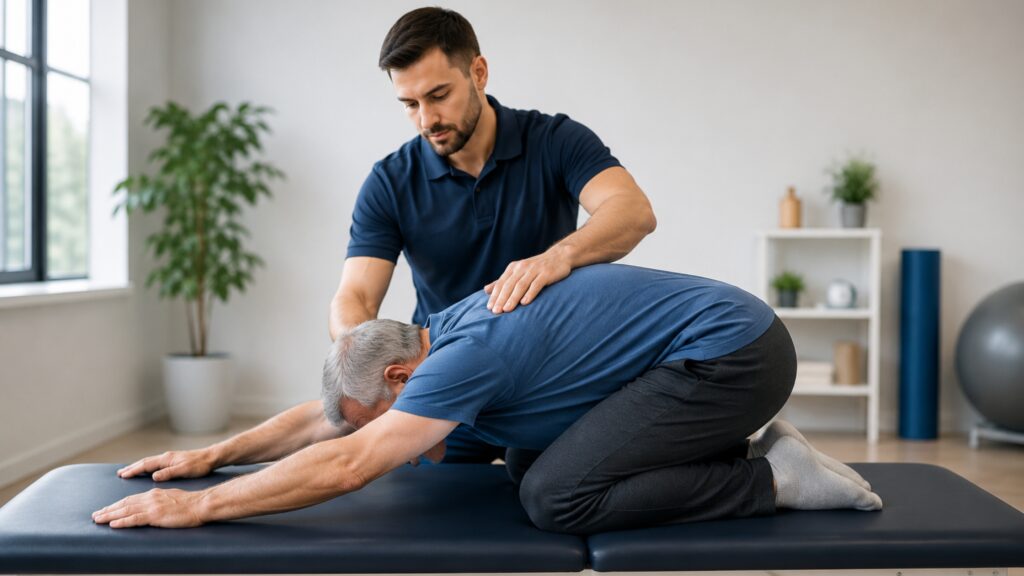
Lumbar flexion exercises are the most evidence-supported movement category for spinal stenosis, according to a peer-reviewed systematic review published in PMC. Movements like the knee-to-chest stretch and the seated forward bend increase the diameter of the spinal canal and reduce direct pressure on compressed nerve roots. These exercises also stretch the posterior spinal ligaments, which often thicken and contribute to canal narrowing in lumbar spinal stenosis. The APTA-affiliated resource ChoosePT notes that nerve root decompression movements are a foundational component of nearly every spinal stenosis PT protocol. Patients typically notice reduced leg pain and neurogenic claudication symptoms within the first two to three weeks of consistent practice.
Core Stabilization and Muscle Strength Training
Weak deep spinal stabilizers force stenotic vertebral segments to bear more mechanical load with every step. The PMC systematic review found that muscle control exercises — targeting the transverse abdominis, multifidus, and lumbar extensors — significantly reduce pain and improve function in lumbar spinal stenosis patients. Core stabilization does not mean doing crunches. It means training the deep muscles that hold spinal segments in a neutral, decompressed position. Core strengthening exercises for back pain relief build the endurance these muscles need to protect your spine during prolonged standing and walking.
Spinal Stenosis Exercises to Avoid—and Why
Lumbar extension movements are the primary category of exercises that can worsen spinal stenosis. Extension narrows the spinal canal further, directly increasing nerve root compression. Avoid back bends, McKenzie extension exercises, and any movement that arches the lower back. Heavy overhead loading — such as barbell squats or military presses — compresses the lumbar spine vertically and aggravates stenotic segments. High-impact activities like running on hard surfaces send repetitive compressive forces through an already narrowed canal. Even seemingly harmless movements like prolonged standing with a hyperextended lower back can spike neurogenic claudication symptoms.
How Long Does Physical Therapy for Spinal Stenosis Take?
A typical physical therapy program for spinal stenosis runs 6 to 12 weeks, with 2 to 3 sessions per week. Most patients complete 18 to 36 total visits before transitioning to an independent home exercise program. Pain relief often begins within the first two to four weeks as nerve root compression decreases and supporting muscles strengthen. Functional improvements — walking longer distances, standing without leg pain — typically follow by weeks six through eight. Patients with severe stenosis or significant neurogenic claudication may need the full 12-week program before achieving stable results. Consistency between sessions matters as much as the sessions themselves.
Can Physical Therapy Make Spinal Stenosis Worse?
PT can worsen spinal stenosis symptoms if the wrong techniques are applied. Lumbar extension-based protocols, aggressive spinal manipulation at stenotic levels, and high-intensity exercise programs are the most common culprits. Stop your PT program and contact your provider immediately if you notice increased radiating leg pain (radiculopathy), new or worsening bladder or bowel dysfunction, or sudden loss of leg strength. These are red-flag symptoms that may indicate significant nerve compression requiring urgent medical evaluation. A qualified physical therapist will screen for these risks at your initial evaluation and avoid any technique that loads the spine into extension. When PT is matched correctly to the flexion-biased nature of spinal stenosis, the risk of worsening is low.
What to Expect at Your First Physical Therapy Appointment
Your first appointment is an evaluation, not a workout. Your physical therapist will assess your gait, looking for the characteristic forward-leaning posture that many stenosis patients adopt to relieve neurogenic claudication. They will perform range-of-motion testing to identify which spinal movements provoke or relieve your symptoms. A posture assessment identifies the postural habits that may be increasing spinal canal narrowing throughout your day. You will answer questions about pain location, leg symptoms, and how far you can walk before symptoms force you to stop. Based on this evaluation, your therapist builds an individualized treatment plan. Most patients leave the first session with two or three gentle exercises to begin at home before their next visit.

FAQs
1. Is physical therapy as effective as surgery for lumbar spinal stenosis?
Yes. The SPORT trial, cited by Harvard Health, found that patients who completed a structured PT program achieved pain relief and functional improvement comparable to those who had decompression surgery. PT carries significantly lower risk and is the recommended first-line treatment for lumbar spinal stenosis.
2. How long does a typical physical therapy program for spinal stenosis last?
Most programs last 6 to 12 weeks, with 2 to 3 sessions per week. Patients with moderate symptoms often see meaningful improvement by week four. Severe stenosis may require the full 12-week course before symptoms stabilize.
3. Can physical therapy make spinal stenosis worse?
It can if the wrong techniques are used — particularly lumbar extension exercises or aggressive spinal manipulation. Red-flag signs that PT may be worsening your condition include increased leg radiculopathy, new bladder or bowel symptoms, or sudden weakness. Report these to your therapist and physician immediately.
4. What exercises should people with spinal stenosis avoid?
Avoid lumbar extension movements, back bends, heavy overhead loading, and high-impact activities like running. These movements narrow the spinal canal further and increase nerve root compression. Focus instead on flexion-based exercises that open the canal.
5. Is walking good exercise for spinal stenosis?
Yes, with modification. Walking on flat surfaces at a comfortable pace is beneficial. Use a slight forward lean or walk with a shopping cart or walking aid if needed — this flexion posture opens the spinal canal. Avoid prolonged walking that triggers leg pain or neurogenic claudication without rest breaks.
6. What is the best sleeping position for spinal stenosis pain relief?
Sleeping on your side with your knees pulled slightly toward your chest (fetal position) keeps the lumbar spine in mild flexion, which opens the spinal canal and reduces nerve compression overnight. Placing a pillow between your knees reduces rotational stress on the L4-L5 level.
7. Which physical therapy techniques provide the fastest pain relief for spinal stenosis?
Lumbar flexion exercises and soft tissue massage typically produce the fastest initial symptom relief. Flexion movements decompress nerve roots directly, while massage reduces the muscle guarding that amplifies pain. Most patients notice reduced leg symptoms within the first two to three weeks of consistent treatment.
8. When should someone with spinal stenosis consider surgery instead of PT?
Consider when to consider surgery for spinal stenosis if you experience progressive neurological deficits — worsening leg weakness, loss of bladder or bowel control, or inability to walk even short distances — after completing a full 12-week PT program. The Mayo Clinic recommends surgery only when conservative treatment has failed and quality of life is severely impaired.